

West Bengal Biodiversity Board
The term “sustainability” was first coined by Hans Carl von Carlowitz in 1713 in his book on forestry meaning a long-term, stable supply. Later the concept was expanded to its broader modern meaning of “Sustainable Development” in the report of the Brundtland Commission named “Our Common Future” in 1987, more than 38 years ago. Since then the concept of sustainability has gained currency over the years.
Environmental sustainability means using natural resources wisely so we can meet our needs today without harming the ability of future generations to meet theirs. It’s about finding a balance between improving our lives and protecting nature. The scientific discoveries coupled with technological advancements had promoted rapid industrialisation since the 19th century. Life became easier but the ecological cost was massive.
Urbanisation is unavoidable. According to an estimate urbanization in India will rise to 53% by 2050. Such rapid pace of urbanization produces a big challenge. Cities are built by modifying existing environments. Once an area, which used to be a lush green, thickly vegetated and dotted with waterbodies, has turned into a built-up, concretised, wrapped up with overbridges, producer of pollutants from emissions, industrial activities and power generations. The adverse results are being witnessed in the form of intense heatwave, irregular rain, seasonal public health emergencies, water scarcity, flooding which shows that urban and peri-urban ecologies are in peril.
The United Nations announced 17 Sustainable Development Goals (SDGs), to help the world deal with important problems like poverty, pollution, and unfairness etc.- encompassing all possible domains of human development and happiness. These goals aim to make the world a better place by 2030—where people live in peace, the planet is protected, and everyone has the chance to live well. All countries in the UN agreed to these goals in 2015. They encourage governments, businesses, and everyday people to work together to build a fairer and more sustainable future.
Across the globe, sustainability has long been the focus of countless conferences, committees, scientific discussions, research projects, and international agreements. But despite all these activity, are we truly seeing the real benefits of these efforts at the grassroots level?
One key reason may be, a large section of our population is routinely left out of these conversations. Perhaps it stems from a lack of trust in their reasoning and intelligence. But by excluding them, we also lose out on the opportunity to build solutions that are inclusive, practical, and rooted in everyday realities.
Author Richard Louv, in his book ‘Childhood’s Future’ has explored a child’s relationship with nature. He noticed an increasing divide between the young and the natural, and the social, spiritual, psychological and environmental implications on this change. He used a term ‘Nature-deficit disorder’. He observed diminished use of senses, attention difficulties, higher rates of physical and emotional illness. All these affects the future stewardships of nature.
Nature is the first window of wonder to a child. Experiences in the natural world offer great benefits to psychological and physical health. Research proved that time spent in nature build confidence and calmness, reduce attention deficiency among kids. If we can plant the seed of sustainability in young minds, it will go a long way in shaping the future contours of the global sustainability movement.
In a recent study West Bengal ranked 13th among the India States for its performance on the Sustainable Development Goals in the 2023-2024. Though the state has made progress in areas like clean energy, peace, justice, and health, it lags in climate action, sustainable cities, and life on land goals. If we can leverage the untapped potentiality of the young minds our sustainability target can be narrowed down.
Some activity based conservation programmes involving school students are discussed here, which are scalable with measurable impact on sustainability.
Conservation of traditional vegetables by creating Kitchen Gardens:
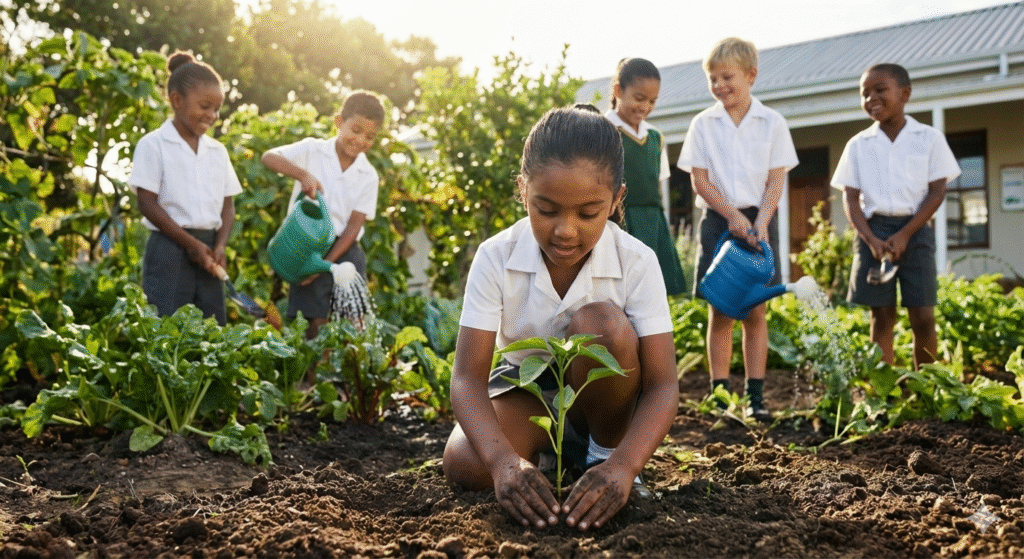
Due to the dominance of commercial agriculture, many varieties of indigenous vegetables are on the verge of disappearing. This crisis is further intensified by the impacts of climate change, monoculture farming practices, and the widespread use of hybrid seeds. As a result, the nutritional value and affordability of local vegetables have moved beyond the reach of many. In this context, school kitchen gardens can play a vital role in providing nutritious food for children’s meals.
The primary objective of this initiative is to provide students with hands-on learning about sustainability through practical activities such as preparing garden soil, collecting seeds, sowing them, applying organic fertilizers, watering regularly, and maintaining the cleanliness of the garden. Kitchen garden within a school campus serves multiple purposes: it acts as a living laboratory, promote conservation of traditional vegetables, supplement mid-day meals with fresh and organic vegetables. It also inculcates the practice of seed preservation for the next season. This model is very much impactful in supporting conservation of traditional vegetables besides fostering ecological awareness, securing food security under the threat of climate change and stewards towards a sustainable future. In West Bengal, this initiative can be undertaken in any school that has 4000-7000 square feet of open space.
No matter which profession these children pursue in the future, the lessons they learn at a young age will stay with them and continue to shape their values and actions throughout every stage of their lives.
Creation of Butterfly Conservation Areas:
Butterflies are considered as indicators of a healthy environment and ecosystems. It plays a vital role in local pollination and health of local biodiversity & ecosystem. Due to the increasing pressure of human population their natural habitat is lost in many areas. A butterfly conservation area is considered as integrated management practice to protect them. In a butterfly conservation area local host and nectar plants of butterflies are given protection in their native habitats, and caterpillars are reared on them.
Creating a butterfly garden within the school compound is a valuable initiative that promotes ecological awareness and sustainability among students. By actively involving children in the planning, planting, and maintenance of the garden, they gain hands-on experience with biodiversity, pollination, and the importance of native plants. This practical engagement helps them understand the interconnectedness of ecosystems and the role that even small efforts can play in conserving nature. This initiative can be started in any interested school that has 1,500 square feet of open space.
Such initiatives nurture a sense of environmental responsibility and appreciation for wildlife from an early age. It encourages sustainable practices like organic gardening, water conservation, and habitat protection. By fostering these values in young minds, foundation is laid for a generation that is better equipped to lead and support future movements for environmental sustainability.
Green Fencing of School compound with Medicinal Tall Trees
Creating green fencing with medicinal tall trees around the school compound is a meaningful initiative that promotes ecological awareness and sustainability among students. Involving students in planting and caring for these trees provides hands-on learning about the value of plants, especially those with medicinal properties, and their role in maintaining ecological balance.
This green barrier not only enhances the school’s environment by improving air quality, reducing noise, supporting biodiversity and offering shade, but also serves as a living classroom for environmental education. Students learn about native medicinal species, traditional knowledge on the species, and sustainable practices, fostering a deeper connection with nature. Such early exposure is essential in shaping environmentally responsible individuals who can lead future sustainability movements with understanding and commitment.
Indigenous Fish Conservation areas
For several years now, ponds, wetlands, canals, and small water bodies in suburban and rural areas have been steadily disappearing — a quiet erosion shaped by the passage of time. Along with them, various native fish species are also vanishing.
In a time when life was not so deeply entangled in the calculations of profit and loss, these indigenous fish served as an affordable and accessible source of protein for poor and rural communities. People would catch them using different types of nets, fishing rods, or even the towels they wore — not for commerce, but for their own nourishment.
But today, those natural habitats are under threat. And where there is no habitat, there can be no fish. Reintroduction of these indigenous fishes in the natural ecosystem would serve as an important step to keep the source of cheap protein intact in the daily platter of a common man. Through this initiative, along with native fish species, various aquatic plant species can also be conserved.
Involving students in such activities, especially from the rural and peri-urban areas wherever suitable infrastructure is available, not only increases the knowledge about native fish but also encourages them to help preserve these species and their habitats as well. A Govt. owned waterbody with at least 0.5-acre water spread area is ideal for this initiative.
School Wall painting with biodiversity theme
This could be a great idea—to let students paint the boundary walls of the school with pictures of different plants, animals, and other parts of nature. Since students are the future of our society, this activity will help them learn more about the biodiversity around them in a fun and active way. It can also encourage them to care about nature and take steps to protect and preserve it in the future. In this regard, the school authorities may seek the assistance of an expert to guide the painting process. A wall measuring at least 300 to 500 square feet, located along the roadside and flanking both sides of the school entrance, would be ideal for this purpose.
Taking students on a biodiversity tour
The rapid depletion of biodiversity poses a serious threat to the planet, despite the fact that biodiversity is essential for sustaining life. In the race to meet the immediate demands of a growing population, human activity has caused significant damage to ecosystems—our very lifeline. While economic development is vital to improve the lives of millions suffering from poverty and hunger, it must be balanced with ecological responsibility. True development must be both people-centric and conservation-based. Without protecting the natural systems that support all life, development will eventually erode the very foundation it relies on.
From this urgent environmental standpoint, raising awareness about biodiversity among school students has become crucial. One impactful way to achieve this is through Bio-Tours—guided educational visits to natural habitats where students can observe biodiversity first-hand. Such experiential learning helps students connect with nature in a meaningful way, deepening their understanding of its value and fragility.
Bio-tours not only enrich students’ knowledge but also inspire a sense of responsibility toward environmental stewardship. By engaging with ecosystems directly, students are more likely to develop a lifelong commitment to protecting and conserving biodiversity. This early exposure can play a key role in shaping future citizens who value sustainability and work actively towards a healthier planet.
Through collective effort, these initiatives can be given an institutional form
The West Bengal Biodiversity Board has been undertaking all the above-mentioned initiatives for several years. Since the beginning, Government/Govt. Aided/Govt. sponsored primary/secondary educational institutions have shown growing interest in these efforts, with their enthusiasm steadily increasing over time. So far, these initiatives have been implemented in nearly 400-600 schools across West Bengal. However, due to institutional and financial limitations, there has been a challenge in expanding these initiatives on a larger scale.
If government bodies, corporates, and non-profits join hands to institutionalize these initiatives, their reach and impact can be expanded manifold — transforming these efforts into a powerful, sustainable movement for lasting change.
It is our responsibility to prepare the next generation from now so that they are equipped to cope with the challenges of a climate-altered future with a sustainable lifestyle.